Dunsyre Castle
Dunsyre Castle once stood about 300 yards from the parish kirk. It was a tower of the type common across lowland Scotland: a vault on the ground floor, two apartments above, reached by a circular staircase at one of the corners. Until the mid-eighteenth century it served as the seat of a baronial court. Little survives above ground today.
The Statistical Account of 1834 adds a vivid detail. In the vault beneath the tower, the Baron Baillie held his courts, keeping his instruments of torture: the thumbkins and the boots, devices used to extract confessions by crushing the thumbs and legs. When the last baron died, who "is represented to have exercised a tyrannical sway," the people of the village met and destroyed them. It's a rare instance in local history of a community collectively and physically dismantling the apparatus of arbitrary power.
The fortalices of the valley
Dunsyre Castle was not the only fortified building in the parish. The Statistical Account records that the valley once held a number of structures known as fortalices, small fortified towers that served as seats of local power and refuge. At Easter Saxton alone there were no fewer than five. At Todholes, at the west end of the parish, stood one of considerable strength, with a fosse (a defensive ditch) around it. Further towers stood at Westhall Hills and Auston. The number of these structures across a relatively small parish suggests it was a well-settled and carefully controlled territory in the medieval period.
Westhall Tower
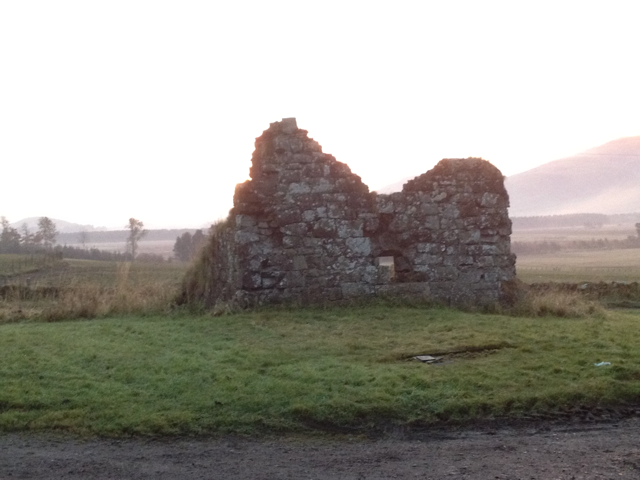
Of all the fortified buildings in the parish, Westhall Tower is the best preserved. A sixteenth-century structure at Westhall Farm, it remains a visible link to the parish's medieval past and stands in considerably better condition than the ruins of Dunsyre Castle itself.
Ownership of the barony
The ownership of Dunsyre passed through several prominent families over the centuries. The earliest recorded proprietors are the Gourlays, from whom it passed by marriage to the Somervilles in the mid-twelfth century. By 1147, William de Sommerville, third of that family, had married the daughter of Gualter, Lord of Dunsyre, the earliest specific record of ownership in the parish.
By the fourteenth century the estate had come to the Newbigging family, and in 1368 it was granted to the Douglas Earls of Douglas. The Hepburns of Hales held Dunsyre in the fifteenth century: Sir Patrick Hepburn was designed of Dunsyre in 1450, was created a Baron by James III, and his successors were created Earls of Bothwell in 1488. The last of the Hepburn line, the same Earl of Bothwell who would marry Mary Queen of Scots, was created Duke of Orkney by the queen. The Archibald, sixth Earl of Angus then came to hold the property through an exchange with the Earl of Bothwell, trading the castle and lands of Hermitage in Liddesdale for the castle of Bothwell in Clydesdale, and so the Douglases acquired Dunsyre.
In the seventeenth century the estate was sold to Sir George Lockhart, one of the most eminent lawyers in Scotland, and it has remained connected to the Lockhart family ever since. The estate lands in this part of Lanarkshire continue to be held through Lee and Carnwath Estates today.
Sources
New Statistical Account of Scotland (1845), Vol. VI, Lanark, Parish of Dunsyre. Available via the EDINA Statistical Accounts service.
Dunsyre historical perspective, Scottish Places