"De curia loquor et nescio, Deus scit, quid sit curia."
"I speak of the court and I know not, God knows, what a court is." — Walter Map, 12th century
What the court book is
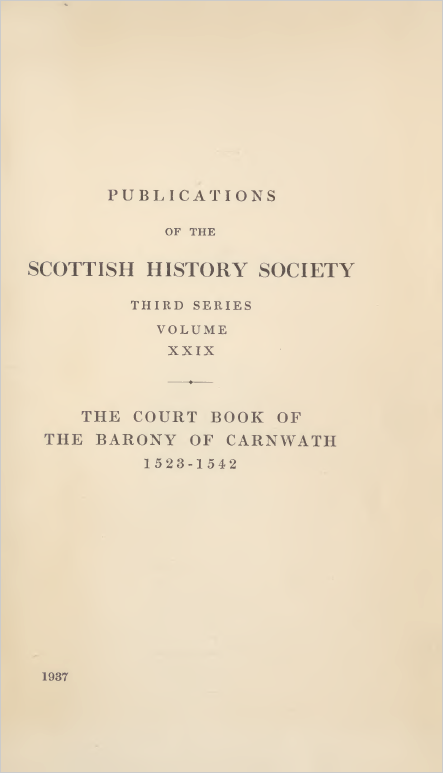
The Court Book of the Barony of Carnwath 1523–1542 is one of the finest surviving records of Scottish baronial justice. Edited by W.C. Dickinson and published by the Scottish History Society in 1937, it preserves nearly two decades of proceedings from the court of the Barony of Carnwath, held at the town of Carnwath in Lanarkshire, a few miles from Dunsyre. It is not a legal treatise or an administrative summary. It is the working record of an actual court: cases heard, names called, fines imposed, sureties taken, and disputes resolved week by week across a rural community.
Baronial courts were the primary mechanism of local justice in Scotland for centuries. Every barony had one. The baron, or more usually his appointed bailies, presided over disputes between tenants, punished breaches of the peace, regulated the use of common land, and enforced the obligations that held a farming community together. For most people living in and around Dunsyre in the sixteenth century, the barony court was the only court they would ever encounter.
The language of the record
The court book is written in two languages, often within the same entry. The formal heading of each session, the date, the names of the presiding bailies, the identity of the lord, is recorded in Latin, the language of legal authority across medieval Europe. The proceedings themselves are written in Middle Scots: the form of Scots used in official and legal documents from roughly the fourteenth to the seventeenth century.
Middle Scots looks formidable on the page. The spelling is phonetic and inconsistent, contractions are common, and several letters are used differently from modern English. But it is not a foreign language. Read aloud, it resolves into something very close to spoken Scots. Quh is simply wh. V stands for u. I stands for j. The word quhilk is which. Lauchfull is lawful. Comperit is appeared. Once those conventions are understood, the voice of the clerk comes through clearly: precise, formulaic, and occasionally revealing more than it intends to.
Thomas Mollisone, Town Clerk of Aberdeen, already knew this difficulty in 1591, writing of the early court books:
"Onlie suitis and actionis... euil to be red, be resoun of the antiquitie of the wreit, and forme of the letter or charecter, weray schortlie and compendiouslie wretin, quhilk is not now vsit; and skairslie gif ony man can reid the samyn."
His point, that only suits and actions are recorded, written so briefly and in such an old hand that barely anyone can read them, applies equally to the Carnwath book. The clerk was not writing for posterity. He was recording what was decided and by whom, in the most efficient form possible.
The connection to Dunsyre
Carnwath lies only a few miles from Dunsyre, and the two communities were tightly bound together by geography, landholding, and the reach of baronial authority. The Barony of Carnwath was held by the Somervilles, the same family who had acquired Dunsyre by marriage in the twelfth century. Hugh, Lord Somervell, whose court this was, presided over a territory that encompassed much of the ground between the two settlements.
The connection is not merely administrative. The jury lists in the court book name men drawn from across the surrounding area. In the session of 25 October 1536, the assize includes Robert Graham in Dunsyre (the name is truncated in the manuscript, almost certainly as "Duns-", but the identification with Dunsyre is well established) sitting alongside Thomas Justice in Newbigging and men from Covington, Forth, and Raploch. People from Dunsyre were not spectators of this court. They sat on its juries, appeared before it as parties, and lived within its jurisdiction.
A court session in action
The session of 25 October 1536 gives a clear picture of how the court worked in practice. The case before it concerned William Anderson of Howburn, who had been cited three separate times: for drawing blood from William Graham in Spittal, for drawing blood from Andrew Michael in Carnwath, and for drawing blood from Thomas Purdy, a creel-man. Anderson was a man who had, in short, been fighting.
The original record reads:
"The quhilk day William andersone in howbwrne oft tymes callit to entir as he that was arrestyt be my lordis precep to this court for violent bluyd drawin upone william grahayme in spittall as he that upheld his hande and his gudis to entir to this court And in lykwys was arrestit for violent bluyd drawin upone andro michael in carnewyth And als was arrestit for the violent bluyd drawin upone thomas purdy creillman And for thir arrestmentis the sayd William andersone oft tymes callit & nocht comperit Is in ane mercyment of this court sic as he aucht to tyne of law..."
In modern English: On which day William Anderson in Howburn, often times called to appear, as one who was cited by my lord's precept to this court for violent blood drawn upon William Graham in Spittal... and also for violent blood drawn upon Thomas Purdy, creel-man. And for these citations the said William Anderson, often called and not having appeared, is subject to an amercement of this court such as he ought to forfeit by law.
Anderson had repeatedly failed to appear. He was fined for each absence. When he finally came before the court, he asked permission for friends to speak on his behalf, and named two clergymen to act as his advocates: Sir William Weir, vicar of Carnwath, and Master John Weir, vicar of Petinain. They argued that their client needed more time to prepare his defence and asked for a fifteen-day adjournment. Lord Somervell pushed back: Anderson had been bound to appear long ago and had already had time enough. But in the end, acting in his own words "of his own good will," the lord conceded. A new date was set for 8 November, and sureties were taken not only from Anderson but from all three men he had allegedly wounded. Everyone was required to guarantee their return.
The language explained
Several words in the record carry specific legal meaning that is not obvious from the text alone.
Violent bluyd (violent blood) was a precise legal term. Any assault that caused bleeding was an offence against the baron, because the bloodshed had defiled his ground. The lord was entitled to a fine for that defilement, entirely separate from any remedy owed to the victim. This is why the record says the lord "caused pursuit" of Anderson for the "fyling" (defiling) of his ground. The injury to the victim was secondary, in legal terms, to the insult to the lord's land.
Creillman. A creel was a large wicker basket used to carry goods. A creel-man was a carrier, someone who transported goods between farms, villages, and markets. Thomas Purdy was, in other words, a working man of no particular social standing, moving through the landscape doing ordinary trade. His presence in the case as a victim alongside a tenant in Spittal and a man in Carnwath suggests Anderson's violence was indiscriminate rather than targeted.
Borowis (sureties) were guarantors: men who pledged that a party would appear when required, under financial penalty if they did not. The court routinely took sureties from all parties in a dispute, not only the accused. This kept everyone invested in the process and gave the court practical leverage over people who might otherwise simply disappear.
Amercement was a fine imposed at the discretion of the court, literally "at the mercy" of the presiding officer. Absence from a court to which you had been summoned was an automatic amercement. Anderson accumulated several before he finally appeared.
Peremptour (peremptory) meant final. A peremptory court allowed no further adjournment. Anderson's new court date of 8 November was fixed as peremptory, which is why the surety was raised from £20 to £25. There would be no third chance.
What the court meant to local people
For the men and women living in and around Dunsyre in the sixteenth century, the barony court was not an abstract institution. It was a practical, recurring fact of life: the mechanism by which land was held, disputes were settled, and order was maintained in a community with no police, no solicitors, and no county council.
If your neighbour's cattle strayed onto your grain, you went to the court. If someone owed you money and would not pay, you went to the court. If you were assaulted, beaten, or had blood drawn, the court was where the matter was heard, not on your behalf, primarily, but on behalf of the lord whose ground had been defiled. Your injury was the occasion. The lord's fine was the point.
The court also regulated the rhythms of farming: who could graze animals on the common, who had to maintain which dykes and ditches, how grain was to be measured, when rents fell due. It recorded inheritances and confirmed who held which land. A tenant who ignored its summons accumulated fines. One who defied it entirely risked forfeiture. Compliance was not optional.
But the court was also, in its way, a community institution. Jurors were drawn from the neighbourhood: Robert Graham from Dunsyre, Thomas Justice from Newbigging, men from Forth and Covington who knew the land, the people, and the disputes they were being asked to judge. Advocates could be parish clergy. Adjournments were granted when a man argued he needed more time. Even Lord Somervell, insisting that Anderson had had time enough, ultimately conceded "of his own good will." The record is formal, but the human negotiation behind it is visible on every page.
For ordinary people in this part of Lanarkshire, the barony court was where the law actually lived, not in Edinburgh, not in Parliament, but in a room in Carnwath, on a cold October morning, with a clerk writing it all down in a hand that would eventually be very difficult to read.
Source
W.C. Dickinson (ed.), The Court Book of the Barony of Carnwath 1523–1542, Scottish History Society, Third Series, Vol. XXIX (Edinburgh, 1937). Available via the Scottish History Society and major academic libraries.