In 1834, the minister of Dunsyre, the Rev. William Meek, compiled his account of the parish for the New Statistical Account of Scotland, a nationwide survey of every parish carried out by the Church of Scotland in the 1830s and 1840s. What Meek wrote is a snapshot of a community in the last years before the railways arrived: its landscape, its people, their work, their wages, and a few things that caught his attention as curiosities. The account was published in the New Statistical Account of Scotland in 1845.
The watershed
Meek noted that the parish sits on a watershed between two of Scotland's great river systems. The higher ground of the parish drains north into the Clyde, while the streams from the southern slopes run eventually into the Tweed. The ridge between them runs through the hill ground above the village. It is a quiet, unremarkable feature of the landscape today, but Meek regarded it as worth recording, a reminder that Dunsyre sits at a point of genuine geographical significance, dividing the Atlantic drainage from the North Sea.
The South Medwin
Meek was particularly admiring of the South Medwin Water, which flows through the valley below the village. He described it as "beautifully clear" and noted that its trout were "superior to those of the Clyde or the Tweed in delicacy of flavour," high praise from a minister writing in one of the great Scottish angling counties. Pike were also present in the river, though Meek does not record them with the same enthusiasm.
By 1834 the river had already been significantly altered. Meek records that around 1832, a stretch of the South Medwin was straightened, approximately three miles of the channel were re-routed and the banks regularised as part of the agricultural improvement of the lower valley. The work was left incomplete, however, halted by a mill-dam that created practical difficulties the improvers evidently chose not to resolve.
"The water is beautifully clear, and the trout taken in it are superior, in delicacy of flavour, to those of the Clyde or the Tweed."
Craneloch
On the higher ground of the parish sits Craneloch, a small loch at elevation, with dark, peaty water characteristic of upland moorland. Meek describes it as lying "unmolested" and notes that it held pike and perch, which at that date had apparently been left largely undisturbed. The loch sits above the valley in a landscape of rough moorland, fed by rainfall from the surrounding hills.
The village and its people
The village of Dunsyre in 1834 was small: Meek records a population of around fifty souls. There were no alehouses, which he evidently regarded as a point in its favour. Carriers went to Edinburgh regularly, connecting the community to the capital for goods and news, though the journey would have been a full day by road.
The population of the parish as a whole had fluctuated considerably over the preceding century, reaching a peak around 1783 and declining sharply thereafter, broadly in line with the pattern of rural depopulation seen across lowland Scotland as agricultural improvement reduced the labour required to work the land.
| Year | Population |
|---|---|
| 1750 | 359 |
| 1783 | 400 |
| 1791 | 360 |
| 1815 | 312 |
| 1821 | 290 |
| 1831 | 335 |
Wages and work
Meek records the wages paid in the parish with the precision of a man who knew how important such details were to anyone reading the account in another parish or another generation. Male farm servants earned between £8 and £12 per year, with board provided on top. Women workers received between £2 and £3 per year. Tradesmen were paid by the day: masons could earn 2 shillings and 6 pence a day, a rate that would have seemed adequate in a rural community with relatively few alternatives.
Fuel
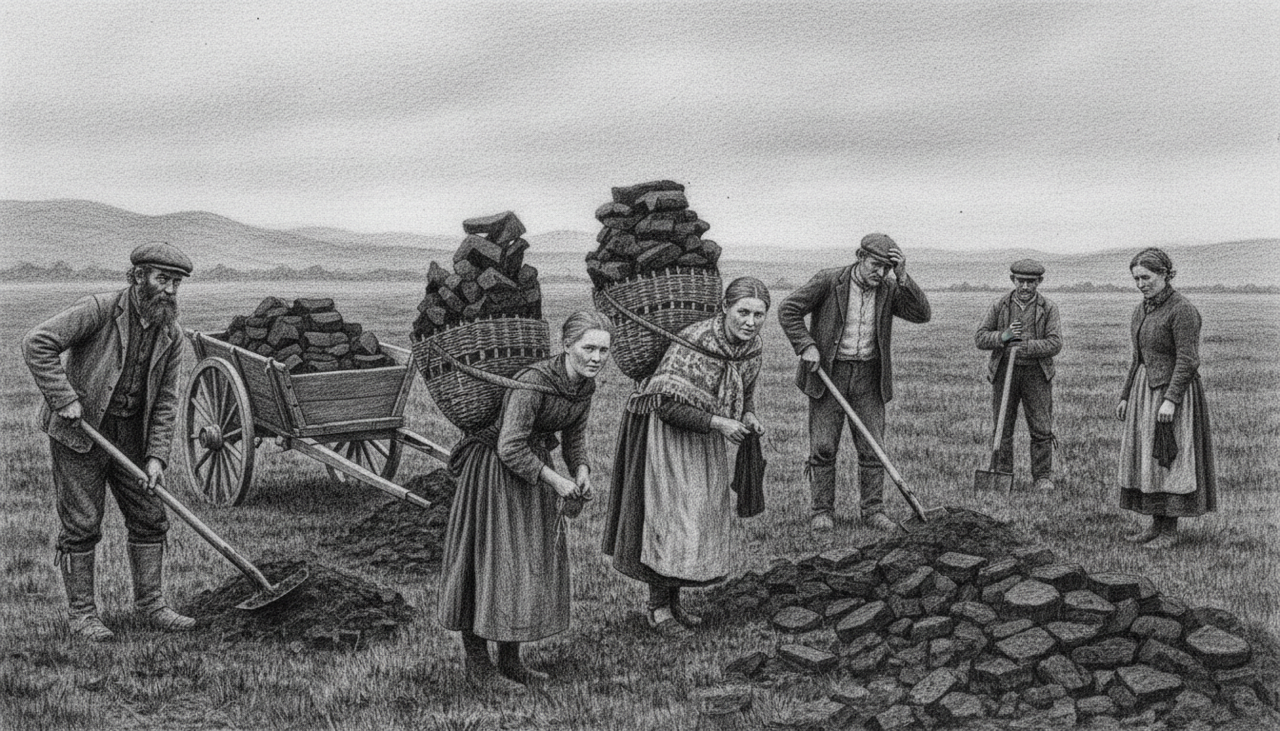
Fuel was a practical concern. Coal could be obtained, but at a cost: it was available from collieries roughly twelve miles distant, and delivered at 12 shillings per ton, a significant expense for a farm household. Peat was the practical alternative for many families. It was cut from the moorland around the parish and from the banks of the South Medwin, and remained in common use in 1834 alongside coal for those who could not afford the cartage from the pits.
A curious natural observation
Meek records one observation that stands out from the practical details of land and labour. From a particular spot in the parish (he doesn't specify exactly where) he had observed not one but three complete rainbow arcs simultaneously. Whether this was a genuine optical phenomenon produced by the particular topography and the angles of the hills, or an instance of a minister's careful enthusiasm for natural wonder, he doesn't say. He simply records it as a fact worth noting.
The castle vault
Meek's account also touches on Dunsyre Castle and its baronial court. He records that the vault beneath the tower (where the Baron Baillie held his courts) contained the instruments used to extract confessions: the thumbkins (which crushed the thumbs) and the boots (which crushed the legs). When the last baron died, the people of the parish met and destroyed them. Meek clearly relished the detail. It was, he implies, a fitting end to an institution whose methods had not endeared it to the community it claimed to serve.
The Covenanters
The Statistical Account records the parish's Covenanting connections briefly but clearly. Meek notes William Veitch's time as a tenant at Westhills, his involvement with the Covenanting army, and his escape through the parish after the Battle of Pentland Hills in 1667. He also records Roger's Kirke, the ravine on the parish boundary where a Covenanting minister took shelter with his congregation, and the "preaching holes" in the moors, natural retreats that had still been named and remembered as late as 1834, though the events that gave them their names were nearly 150 years in the past.
Source
New Statistical Account of Scotland (1845), Vol. VI, Lanark, Parish of Dunsyre, by the Rev. William Meek. Available via the EDINA Statistical Accounts service.